Guide
Laser hair removal versus IPL
IPL and laser both put light into the skin, which is why they get sold as the same thing. They are not. One is a broad flash of many wavelengths, the other a single wavelength aimed at one target.
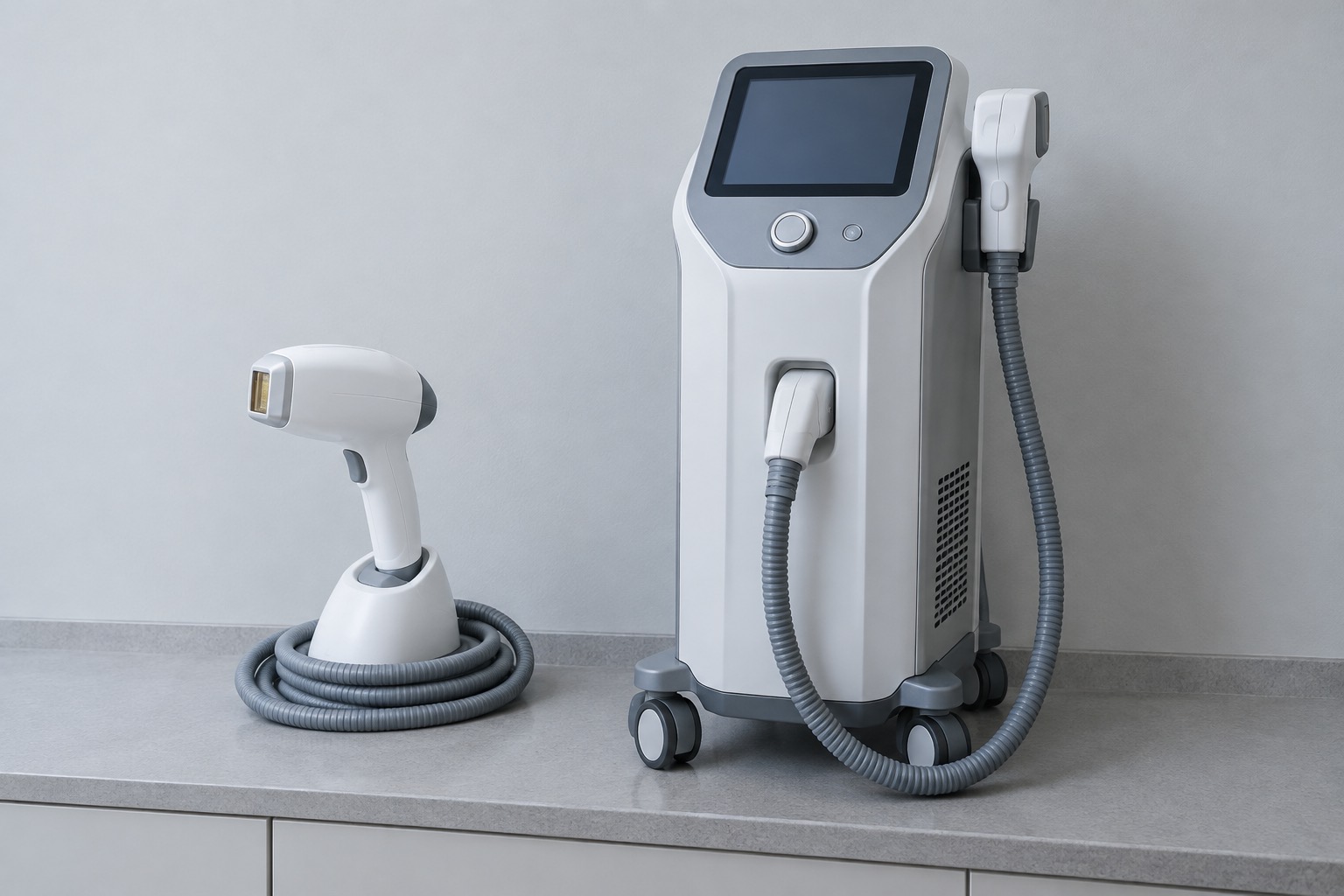
The difference in one paragraph
IPL stands for intense pulsed light. It fires a broad spectrum of wavelengths, filtered to a range, so part of the energy lands on pigment in the hair and part lands on everything else in the skin. Laser emits one wavelength, chosen because melanin absorbs it strongly, and that narrowness is what makes it selective. Broad spectrum light is less selective by definition, so at comparable settings it does less damage per pulse to the follicle and more heating of the skin around it.
Cost across a year of use
IPL is cheaper to build and cheaper to run, which is why the market is full of it, and why most home devices are IPL. Clinic IPL sits between a home device and a laser on both price and effect. Across a year of use, IPL usually costs less than a laser course on the same area, and it usually needs more sessions to get as far, so the gap is narrower than the headline figure suggests.
Laser costs more per session and less per result on suitable hair. That is the comparison that matters if your goal is fewer sessions rather than a lower first payment, and it is the comparison a clinic selling packages will not put on the leaflet. Ask what the total is for a finished result, not for a course.
Permanence and how each one feels
Neither is permanent, and the difference is degree. A full laser course on suitable hair produces a large reduction that most people hold with occasional maintenance. IPL produces a reduction as well, usually smaller for the same number of sessions, and the hair that remains tends to return rather than disappear. Reports of permanent IPL results usually describe a maintenance schedule rather than an endpoint.
IPL is generally the gentler of the two in the room, a warm flash rather than a snap, and the discomfort builds across a session. Laser at effective settings is sharper and faster. Any skin reaction beyond mild short lived redness should be reviewed by a clinician rather than answered with another session.
Time per session
Both are timed by area, and both are far quicker than electrolysis. IPL sessions are often shorter per pass because the devices are gentler, but a course usually contains more appointments, so total time in a clinic can end up similar to laser. On large areas the device matters more than the modality: a current laser with a large spot covers a back quickly, an older IPL with a small window does not.
Spacing matters as much as session length. IPL is usually booked every few weeks and laser every four to six weeks, so a course that looks shorter on the calendar can take the same number of months to finish. Count the months rather than the appointments and you get a fair picture of what either option asks of your time.
Who each option suits, and the honest case for IPL
Laser suits someone with dark hair and clear contrast against their skin who wants the fewest sessions and the largest reduction, and who will pay more up front for that. IPL suits someone on a lower budget, treating a smaller area, or with a low tolerance for discomfort, and it suits anyone whose hair is fine or light brown, where a gentler device is the more realistic option.
Skin tone narrows the choice further. IPL heats pigment in the skin along with pigment in the hair, so on darker skin it carries more risk and does less useful work, and a single wavelength device is the safer starting point. A clinic that offers IPL to every client without looking at their skin is not matching a device to a person.
The honest case for IPL is not that it matches laser. It is that it works, gradually, for less money and less discomfort, and plenty of people are satisfied with the reduction they get. The honest case for laser is that the endpoint arrives sooner and holds longer. Anyone promising permanent removal from either is overselling, and skin that reacts to light treatment should be assessed by a clinician.
Where this sits in the rest of the site
If you are choosing a clinic rather than reading up, start with how the treatment works and what drives the price, then compare the markets we cover and what we verify before you book anything.
Wavelength behaviour, device selection and session structure reflect standard practice for laser hair reduction and IPL. This is not medical advice.